

What Does LEED Stand For? LEED Meaning Explained
 A. Togay Koralturk
Last updated on September 05, 2026
8 min read
A. Togay Koralturk
Last updated on September 05, 2026
8 min read
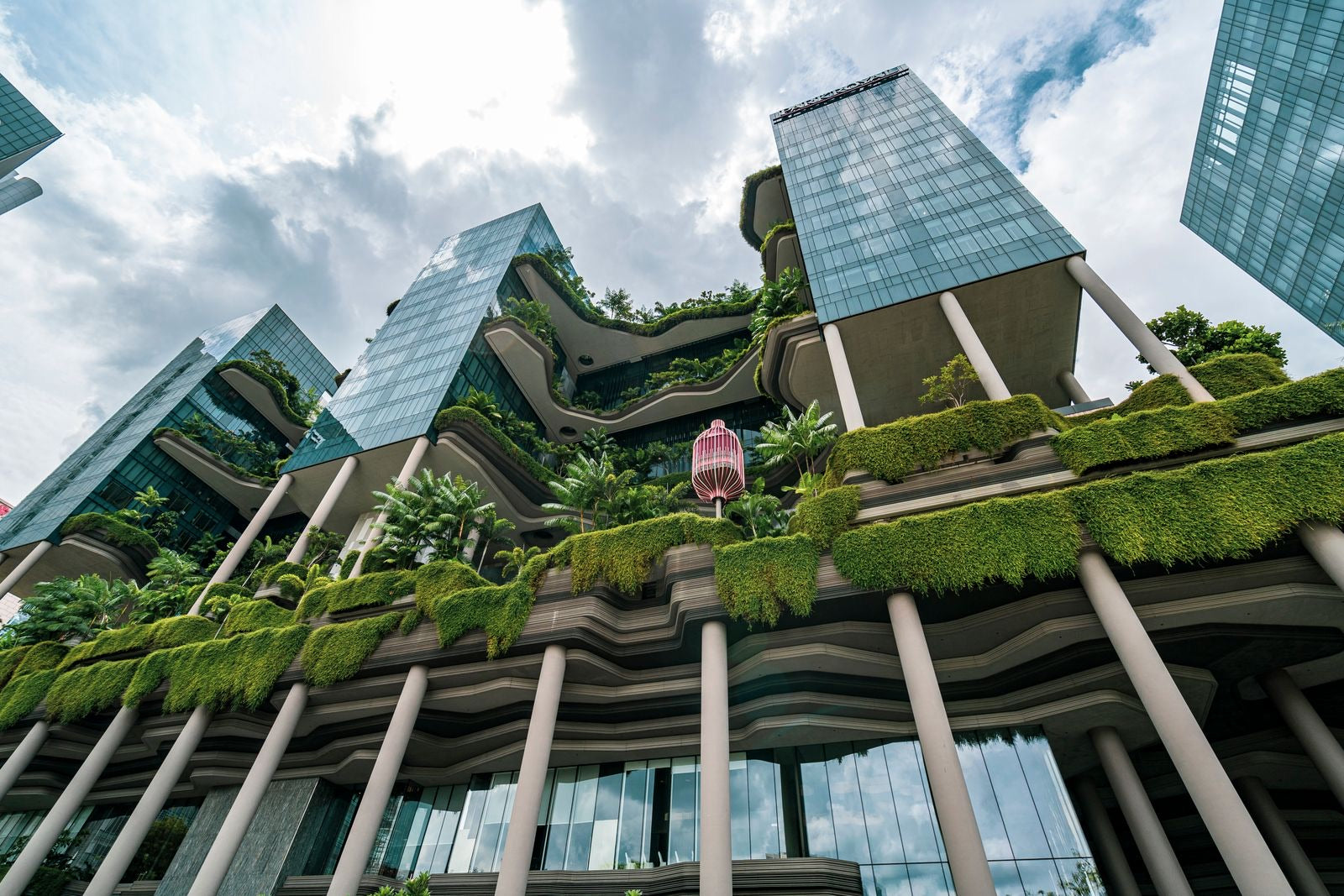

Walk past a newly opened office tower and you may notice a small plaque near the entrance that reads LEED Gold. Those four letters carry a story about how the building was designed, built, and operated. This guide spells out what LEED stands for, what the rating system actually does, who runs it, what LEED-certified means on a real project, and how the term shows up when you start studying for a LEED credential.
What does LEED stand for?
LEED® stands for Leadership in Energy and Environmental Design. It is the name of the green building rating system developed by the U.S. Green Building Council (USGBC), and each word in the acronym was chosen deliberately. Let's consider what each of the four words signals:
| Letter and word | What it signals |
|---|---|
| L — Leadership | LEED is voluntary. Project teams that pursue it choose to go beyond what building codes require, which is why certification reads as leadership rather than compliance. |
| E — Energy | Energy is the largest environmental lever a building has, and it carries the most points in the rating system. |
| E — Environmental | The system looks past the property line: water, materials, land, transportation, and the ecosystems a project touches. |
| D — Design | Sustainability is decided early. The design phase, long before construction begins, is where most of a building's lifetime performance is locked in. |
Notice that the acronym describes an approach, not a technology. There is no single product called LEED that gets installed in a building. Instead, LEED is a framework that measures how responsibly a project handles energy, water, materials, location, and the health of the people inside it.
What is the definition of LEED?
LEED is a green building rating system: a points-based framework that scores how sustainably a building is designed, constructed, and operated, and awards a certification level based on that score. USGBC describes it as the most widely used green building rating system in the world, and projects use it across virtually every building type, from offices and schools to warehouses and hospitals.
To understand the definition, it helps to see the mechanics. A project pursuing LEED works through two kinds of requirements:
- Prerequisites are mandatory. Every project must satisfy them, and they earn no points.
- Credits are optional. Each credit a project achieves earns points, and the total determines the certification level.
Consider a simple example. A new office building must manage the pollution generated by its own construction activity, as that is a prerequisite with no points attached. The same building may then choose to install a high-efficiency water system, and that choice earns credit points. Add up every point the project earns, and the total decides whether the plaque by the door says Certified, Silver, Gold, or Platinum.
In the current version of the rating system, LEED v5, the requirements are organized into eight credit categories and aimed at three impact areas: decarbonization, quality of life, and ecological conservation and restoration. In other words, the definition of LEED today is broader than energy savings alone. It asks what a building does to the climate, to the people inside it, and to the land it occupies.
Ready to earn your LEED credential?
 200,000+ Learners and Counting


Who created LEED? USGBC and GBCI
LEED was created by the U.S. Green Building Council (USGBC), a nonprofit founded in the early 1990s to transform how buildings are designed, built, and operated. USGBC develops the rating system itself: the categories, the prerequisites, the credits, and each new version.
However, USGBC does not review projects or grade exams. That work belongs to its sister organization, Green Business Certification Inc. (GBCI), which administers project certification and professional credentialing exams. The division of labor is easy to remember: USGBC writes the standard, and GBCI verifies against it. We cover both organizations in more detail in our guides to USGBC and GBCI.
One more name is worth knowing. LEED is often called a voluntary, consensus-based, market-driven system. Voluntary, because no law forces a project to pursue it. Consensus-based, because committees of industry experts shape its requirements. Market-driven, because demand from tenants, buyers, and investors is what makes those four letters valuable.
What does LEED mean in construction?
In construction, LEED means a project has committed to a measurable sustainability standard, and that commitment shapes decisions from the first site visit to the final inspection. When a project team says "we are pursuing LEED," several practical things follow.
First, the team registers the project with GBCI and selects the rating system that fits it. In LEED v5, certification is currently available under three rating systems, and the fit depends on the scope of work:
| Rating system | What it covers |
|---|---|
| LEED for Building Design and Construction (BD+C) | New buildings and major renovations |
| LEED for Interior Design and Construction (ID+C) | Interior fit-outs, such as a tenant building out office space |
| LEED for Building Operations and Maintenance (O+M) | Existing buildings improving how they operate |
Second, the sustainability targets enter the drawings and the specifications. The architect orients the building for daylight, the engineer sizes a more efficient HVAC (heating, ventilating, and air conditioning) system, and the contractor plans how construction waste will be diverted from landfill. Each of those decisions maps to a specific prerequisite or credit.
Third, the team documents everything and submits it for review. LEED is a verified standard: a project cannot simply declare itself green. GBCI reviews the documentation, confirms the points, and only then awards the certification. This verification is exactly why the plaque means something to tenants and investors, and why "LEED meaning" in a construction contract is much more concrete than a general promise to build sustainably.
What does LEED-certified mean? The four levels
LEED-certified means a project earned enough verified points to receive one of four certification levels. Projects are scored on the basis of 100 points, and 10 bonus points are also available, which makes 110 points possible in total. The levels are the part of LEED most people encounter first, so let's lay them out:
| Certification level | Points required |
|---|---|
| LEED Certified | 40 to 49 points |
| LEED Silver | 50 to 59 points |
| LEED Gold | 60 to 79 points |
| LEED Platinum | 80 points or more |
Did you notice that 110 total points are available even though the levels are built on a 100-point basis? Just like some exams have bonus questions, LEED has 10 bonus points: a project is scored on the basis of 100 points, and the extra 10 reward innovation and priority achievements. (It is very important to remember this 100-versus-110 distinction for exam purposes.)
Two more details are worth understanding here. The first is that "LEED Certified" is used in two senses: it is the name of the entry level (40 to 49 points), and it is also the umbrella adjective for any project that achieved certification at all. A LEED Gold building is LEED-certified. Context usually makes the meaning clear.
The second detail is newer. In LEED v5, the highest level is no longer a matter of points alone: a Platinum project must also achieve specific decarbonization requirements, such as electrification and reduced embodied carbon, on top of reaching 80 points. The bar for the top of the scale has genuinely risen, which reflects how central decarbonization has become to the entire system.
LEED or lead? Clearing up the spelling
LEED is an acronym, so it is always spelled with a double E and written in capital letters, which distinguishes it from the metal "lead," the verb "to lead," and even an old Scottish word "leed." The confusion is understandable, since all of them sound alike, and search engines see plenty of traffic for both spellings.
LEED for buildings vs. LEED for people
*The word LEED attaches to buildings and to people, and the two mean different things: buildings and projects earn certification, while professionals earn accreditation.* A downtown tower can be LEED Platinum; the engineer who worked on it can be a LEED Green Associate or a LEED AP BD+C. The tower is certified. The engineer is accredited.
Exam tip: LEED rating systems are for buildings and neighborhoods, while LEED credentials are for people. Professionals are accredited; buildings are certified. Keep the two words separated in your mind, because exam questions are written to test exactly this distinction.
The professional side has its own ladder. The LEED Green Associate is the entry credential, proving general knowledge of green building and how LEED works, with no experience requirements to sit for the exam. The LEED AP with specialty, such as LEED AP BD+C, is the advanced credential for professionals working on certification projects. If reading this guide is your first step toward that ladder, our what is LEED overview goes deeper into how the system works, and our best-selling LEED Green Associate Complete Exam Prep Pack covers everything the entry exam tests, backed by the Projectific Passing Guarantee.
Ready to earn your LEED credential?
200,000+ Learners and Counting
Frequently Asked Questions
What does the acronym LEED stand for?
LEED stands for Leadership in Energy and Environmental Design. It is the green building rating system developed by the U.S. Green Building Council (USGBC), and it scores how sustainably a building is designed, constructed, and operated. Projects are scored on the basis of 100 points, with 10 bonus points available, so 110 points are possible in total.
What does LEED stand for in construction?
The acronym expands the same way in every industry: Leadership in Energy and Environmental Design. In construction specifically, pursuing LEED means the project team registers with GBCI, designs and builds to the rating system's prerequisites and credits, documents the work, and has the result verified before certification is awarded.
What does LEED-certified mean?
LEED-certified means a project earned enough verified points under a LEED rating system to achieve one of four levels: Certified (40 to 49 points), Silver (50 to 59), Gold (60 to 79), or Platinum (80 or more). The points are reviewed and confirmed by GBCI, so certification is a verified achievement rather than a self-declared label.
Is it spelled LEED or lead?
The green building rating system is always LEED, capitalized, with a double E, because it is an acronym for Leadership in Energy and Environmental Design. "Lead" is the metal or the verb, and the dictionary word "leed" is an unrelated archaic term. If you are writing about buildings, LEED is the only correct spelling.
Who runs LEED, USGBC or GBCI?
Both, with different jobs. USGBC develops the LEED rating system itself, including each new version. GBCI, its sister organization, administers the system: it reviews project documentation, awards certifications, and runs the professional credentialing exams.
Do I need to know what LEED stands for on the LEED Green Associate exam?
Yes. The exam expects you to know the acronym, the roles of USGBC and GBCI, the certification levels, and especially the distinction that buildings are certified while people are accredited. These fundamentals appear throughout the exam's knowledge areas, so they are among the first things to master when you begin studying.


The LEED Reference Guide Explained: What's Inside [2026]
The LEED reference guide explained: the three rating-system editions, what's inside, how it differs from the candidate handbook, and whether you need it.


The LEED Credit Library: What It Is & How to Use It [2026]
The LEED credit library explained: what lives at usgbc.org/credits, how to filter it to your rating system, and how project teams and exam candidates use it.

LEED Certified Buildings: 13 Famous Examples [2026]
13 famous LEED certified buildings, from the Empire State Building to Apple Park: their certification levels, the strategies behind them, and what they teach.
